When the Meal Was Over Again He Took the Cup
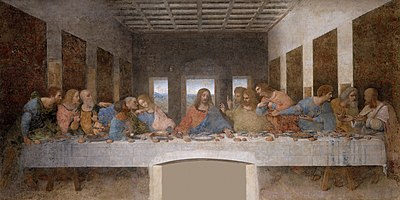
The Last Supper is the last meal that, in the Gospel accounts, Jesus shared with his apostles in Jerusalem before his crucifixion.[ii] The Terminal Supper is commemorated by Christians especially on Maundy Th.[3] The Last Supper provides the scriptural ground for the Eucharist, likewise known equally "Holy Communion" or "The Lord's Supper".[4]
The First Epistle to the Corinthians contains the earliest known mention of the Terminal Supper. The four approved gospels state that the Last Supper took place in the week of Passover, days after Jesus'due south triumphal entry into Jerusalem, and shortly before Jesus was crucified that calendar week.[5] [six] During the meal Jesus predicts his betrayal by 1 of the apostles present, and foretells that before the next morning, Peter will thrice deny knowing him.[5] [half dozen]
The 3 Synoptic Gospels and the First Epistle to the Corinthians include the business relationship of the institution of the Eucharist in which Jesus takes breadstuff, breaks it and gives it to others, saying "This is my torso given to yous" (the apostles are not explicitly mentioned in the account in First Corinthians).[five] [vi] The Gospel of John does non include this episode, but tells of Jesus washing the feet of the apostles,[John thirteen:i–15] giving the new commandment "to honey one another as I accept loved yous",[John 13:33–35] and has a detailed farewell discourse by Jesus, calling the apostles who follow his teachings "friends and not servants", equally he prepares them for his departure.[John xiv–17] [7] [eight]
Some scholars have looked to the Terminal Supper equally the source of early on Christian Eucharistic traditions.[9] [10] [xi] [12] [13] [fourteen] Others see the account of the Concluding Supper as derived from 1st-century eucharistic practice as described by Paul in the mid-50s.[10] [15] [16] [17]
Terminology

The term "Last Supper" does not announced in the New Testament,[18] [19] but traditionally many Christians refer to such an outcome.[19] Many Protestants utilize the term "Lord'south Supper", stating that the term "last" suggests this was i of several meals and not the meal.[20] [21] The term "Lord's Supper" refers both to the biblical upshot and the human action of "Holy Communion" and Eucharistic ("thanksgiving") commemoration within their liturgy. Evangelical Protestants also apply the term "Lord's Supper", just nigh do not utilise the terms "Eucharist" or the word "Holy" with the proper noun "Communion".[22]
The Eastern Orthodox use the term "Mystical Supper" which refers both to the biblical event and the act of Eucharistic celebration inside liturgy.[23] The Russian Orthodox too use the term "Secret Supper" (Church Slavonic: "Тайная вечеря", Taynaya vecherya).
Scriptural ground
The concluding repast that Jesus shared with his apostles is described in all four canonical Gospels (Mt. 26:17–30, Mk. 14:12–26, Lk. 22:7–39 and Jn. 13:i–17:26) equally having taken place in the week of Passover.[24] This meal afterwards became known as the Last Supper.[6] The Terminal Supper was likely a retelling of the events of the terminal meal of Jesus among the early Christian customs, and became a ritual which recounted that meal.[25]
Paul's Kickoff Epistle to the Corinthians,[11:23–26] which was likely written before the Gospels, includes a reference to the Last Supper only emphasizes the theological basis rather than giving a detailed description of the result or its background.[5] [6]
Background and setting

The overall narrative that is shared in all Gospel accounts that leads to the Last Supper is that after the Triumphal entry into Jerusalem early on in the week, and encounters with various people and the Jewish elders, Jesus and his disciples share a meal towards the end of the week. After the meal, Jesus is betrayed, arrested, tried, and and then crucified.[v] [6]
Primal events in the meal are the preparation of the disciples for the departure of Jesus, the predictions about the impending betrayal of Jesus, and the foretelling of the upcoming deprival of Jesus by Apostle Peter.[5] [6]
Prediction of Judas' betrayal
In Matthew 26:24–25, Marker 14:18–21, Luke 22:21–23 and John 13:21–30 during the meal, Jesus predicted that 1 of the apostles nowadays would betray him.[26] Jesus is described as reiterating, despite each apostle's assertion that he would not betray Jesus, that the betrayer would be one of those who were nowadays, and saying that there would exist "woe to the human being who betrays the Son of homo! It would be improve for him if he had not been born."[Marker 14:xx–21]
In Matthew 26:23–25 and John 13:26–27, Judas is specifically identified as the traitor. In the Gospel of John, when asked about the traitor, Jesus states:
"It is the one to whom I volition give this slice of bread when I accept dipped it in the dish." And so, dipping the piece of bread, he gave it to Judas, the son of Simon Iscariot. As soon equally Judas took the staff of life, Satan entered into him.
—Evans 2003, pp. 465–477Fahlbusch 2005, pp. 52–56
Institution of the Eucharist
The three Synoptic Gospel accounts draw the Last Supper as a Passover meal,[24] notwithstanding each gives somewhat different versions of the social club of the repast. In affiliate 26 of the Gospel of Matthew, Jesus prays thanks for the breadstuff, divides it, and hands the pieces of bread to his disciples, proverb "Accept, swallow, this is my body." Later on in the meal Jesus takes a loving cup of wine, offers some other prayer, and gives it to those present, maxim "Drink from information technology, all of you; for this is my blood of the covenant, which is poured out for many for the forgiveness of sins. I tell yous, I will never again drink of this fruit of the vine until that 24-hour interval when I beverage it new with you in my Begetter'southward kingdom."
In chapter 22 of the Gospel of Luke, however, the wine is blest and distributed before the staff of life, followed by the staff of life, so past a second, larger cup of wine, too every bit somewhat unlike wordings. Additionally, according to Paul and Luke, he tells the disciples "do this in remembrance of me." This result has been regarded by Christians of well-nigh denominations as the institution of the Eucharist. There is recorded celebration of the Eucharist by the early Christian community in Jerusalem.[7]
The institution of the Eucharist is recorded in the three Synoptic Gospels and in Paul's First Epistle to the Corinthians. Every bit noted in a higher place, Jesus's words differ slightly in each business relationship. In improver, Luke 22:19b–xx is a disputed text which does not appear in some of the early manuscripts of Luke. Some scholars, therefore, believe that information technology is an interpolation, while others have argued that information technology is original.[27] [28]
A comparison of the accounts given in the Gospels and i Corinthians is shown in the table below, with text from the ASV. The disputed text from Luke 22:19b–20 is in italics.
| Marking fourteen:22–24 | And as they were eating, he took bread, and when he had blessed, he brake information technology, and gave to them, and said, Have ye: this is my trunk. | And he took a cup, and when he had given thanks, he gave to them: and they all drank of it. And he said unto them, 'This is my blood of the covenant, which is poured out for many.' |
|---|---|---|
| Matthew 26:26–28 | And as they were eating, Jesus took bread, and blessed, and brake it; and he gave to the disciples, and said, 'Accept, eat; this is my body.' | And he took a cup, and gave thanks, and gave to them, saying, 'Drinkable ye all of it; for this is my blood of the covenant, which is poured out for many unto remission of sins.' |
| 1 Corinthians 11:23–25 | For I received of the Lord that which likewise I delivered unto you, that the Lord Jesus in the night in which he was betrayed took bread; and when he had given thank you, he brake it, and said, 'This is my body, which is for yous: this exercise in remembrance of me.' | In like fashion also the cup, afterwards supper, proverb, 'This cup is the new covenant in my blood: this do, as ofttimes as ye beverage information technology, in remembrance of me.' |
| Luke 22:xix–twenty | And he took bread, and when he had given cheers, he brake it, and gave to them, saying, 'This is my trunk which is given for you lot: this practice in remembrance of me.' | And the cup in like manner after supper, saying, 'This cup is the new covenant in my blood, even that which is poured out for you.' |
Jesus' actions in sharing the bread and vino accept been linked with Isaiah 53:12 which refers to a blood sacrifice that, as recounted in Exodus 24:viii, Moses offered in social club to seal a covenant with God. Some scholars interpret the description of Jesus' action equally asking his disciples to consider themselves part of a sacrifice, where Jesus is the i due to physically undergo it.[29]
Although the Gospel of John does not include a description of the bread and wine ritual during the Concluding Supper, most scholars agree that John half-dozen:58–59 (the Staff of life of Life Discourse) has a Eucharistic nature and resonates with the "words of institution" used in the Synoptic Gospels and the Pauline writings on the Last Supper.[30]
Prediction of Peter'south denial
In Matthew 26:33–35, Marking fourteen:29–31, Luke 22:33–34 and John 13:36–8 Jesus predicts that Peter volition deny knowledge of him, stating that Peter will disown him three times before the rooster crows the next morning. The three Synoptic Gospels mention that afterward the abort of Jesus, Peter denied knowing him three times, merely after the third denial, heard the rooster crow and recalled the prediction as Jesus turned to look at him. Peter then began to cry bitterly.[31] [32]
Elements unique to the Gospel of John

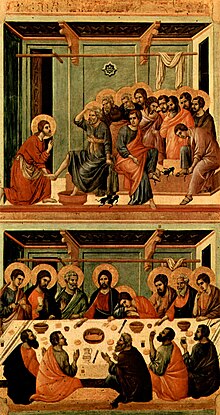
John xiii includes the business relationship of the washing the feet of the Apostles by Jesus earlier the repast.[33] In this episode, Apostle Peter objects and does not want to let Jesus to wash his feet, just Jesus answers him, "Unless I wash you, you accept no part with me",[Jn xiii:eight] after which Peter agrees.
In the Gospel of John, afterwards the departure of Judas from the Final Supper, Jesus tells his remaining disciples [John 13:33] that he will be with them for just a short time, then gives them a New Commandment, stating:[34] [35] "A new control I give you: Love one another. Every bit I have loved y'all, so you lot must love one another. By this everyone will know that you are my disciples, if yous love one another." in John 13:34–35. Two similar statements besides appear later in John 15:12: "My command is this: Love each other equally I take loved you", and John 15:17: "This is my command: Dear each other."[35]
At the Last Supper in the Gospel of John, Jesus gives an extended sermon to his disciples.[John xiv–16] This discourse resembles farewell speeches chosen testaments, in which a father or religious leader, often on the deathbed, leaves instructions for his children or followers.[36]
This sermon is referred to every bit the Adieu discourse of Jesus, and has historically been considered a source of Christian doctrine, specially on the subject of Christology. John 17:one–26 is more often than not known as the Farewell Prayer or the Loftier Priestly Prayer, given that it is an intercession for the coming Church building.[37] The prayer begins with Jesus'south petition for his glorification by the Male parent, given that completion of his piece of work and continues to an intercession for the success of the works of his disciples and the community of his followers.[37]
Time and identify
Appointment

Historians gauge that the date of the crucifixion fell in the range Advertizing 30–36.[38] [39] [xl] Isaac Newton and Colin Humphreys have ruled out the years 31, 32, 35, and 36 on astronomical grounds, leaving 7 April AD xxx and 3 April Advert 33 every bit possible crucifixion dates.[41] Humphreys 2011, pp. 72, 189 proposes narrowing downwardly the date of the Last Supper every bit having occurred in the evening of Wednesday, 1 April AD 33, past revising Annie Jaubert'due south double-Passover theory.
Historically, various attempts to reconcile the iii synoptic accounts with John take been made, some of which are indicated in the Last Supper by Francis Mershman in the 1912 Cosmic Encyclopedia.[42] The Maundy Thursday church tradition assumes that the Final Supper was held on the evening before the crucifixion day (although, strictly speaking, in no Gospel is it unequivocally said that this repast took place on the night earlier Jesus died).[43]
A new approach to resolve this contrast was undertaken in the wake of the excavations at Qumran in the 1950s when Annie Jaubert argued that there were two Passover banquet dates: while the official Jewish lunar calendar had Passover brainstorm on a Friday evening in the yr that Jesus died, a solar calendar was also used, for case past the Essene community at Qumran, which always had the Passover banquet brainstorm on a Tuesday evening. Co-ordinate to Jaubert, Jesus would have celebrated the Passover on Tuesday, and the Jewish authorities iii days later, on Friday.[44]
Humphreys has disagreed with Jaubert'south proposal on the rounds that the Qumran solar Passover would e'er autumn subsequently the official Jewish lunar Passover. He agrees with the approach of two Passover dates, and argues that the Terminal Supper took identify on the evening of Wednesday 1 April 33, based on his recent discovery of the Essene, Samaritan, and Zealot lunar calendar, which is based on Egyptian reckoning.[45] [46]
In a review of Humphreys' book, the Bible scholar William R Telford points out that the not-astronomical parts of his statement are based on the supposition that the chronologies described in the New Testament are historical and based on bystander testimony. In doing so, Telford says, Humphreys has built an argument upon unsound premises which "does violence to the nature of the biblical texts, whose mixture of fact and fiction, tradition and redaction, history and myth all make the rigid awarding of the scientific tool of astronomy to their putative information a misconstrued enterprise."[47]
Location
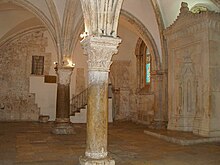
Co-ordinate to later tradition, the Last Supper took place in what is today called The Room of the Last Supper on Mountain Zion, but outside the walls of the Sometime City of Jerusalem, and is traditionally known as The Upper Room. This is based on the account in the Synoptic Gospels that states that Jesus had instructed two disciples (Luke 22:viii specifies that Jesus sent Peter and John) to get to "the urban center" to meet "a man conveying a jar of water", who would lead them to a house, where they would observe "a big upper room furnished and prepare".[Mark 14:xiii–fifteen] In this upper room they "prepare the Passover".
Bargil Pixner claims the original site is located beneath the current structure of the Cenacle on Mountain Zion.[48]
No more than specific indication of the location is given in the New Attestation, and the "metropolis" referred to may be a suburb of Jerusalem, such as Bethany, rather than Jerusalem itself. The traditional location is in an area that, according to archaeology, had a large Essene community, a point made past scholars who suspect a link between Jesus and the group.[49]
Saint Mark's Syrian Orthodox Church in Jerusalem is another possible site for the room in which the Last Supper was held, and contains a Christian stone inscription testifying to early reverence for that spot. Certainly the room they have is older than that of the current coenaculum (crusader – 12th century) and as the room is now underground the relative distance is correct (the streets of 1st century Jerusalem were at least twelve feet (iii.7 metres) lower than those of today, and so any true edifice of that time would take even its upper story currently under the earth). They also have a revered Icon of the Virgin Mary, reputedly painted from life by St Luke.
Theology of the Last Supper
St. Thomas Aquinas viewed The Male parent, Christ, and the Holy Spirit as teachers and masters who provide lessons, at times by example. For Aquinas, the Last Supper and the Cross form the summit of the teaching that wisdom flows from intrinsic grace, rather than external ability.[fifty] For Aquinas, at the Terminal Supper Christ taught by instance, showing the value of humility (every bit reflected in John'due south human foot washing narrative) and self-sacrifice, rather than by exhibiting external, miraculous powers.[50] [51]
Aquinas stated that based on John 15:15 (in the Farewell soapbox) in which Jesus said: "No longer do I call you servants; ...merely I have chosen you friends". Those who are followers of Christ and partake in the Sacrament of the Eucharist become his friends, every bit those gathered at the tabular array of the Last Supper.[50] [51] [52] For Aquinas, at the Final Supper Christ fabricated the promise to be present in the Sacrament of the Eucharist, and to be with those who partake in it, as he was with his disciples at the Last Supper.[53]
John Calvin believed only in the two sacraments of Baptism and the "Lord's Supper" (i.eastward., Eucharist). Thus, his analysis of the Gospel accounts of the Terminal Supper was an important part of his entire theology.[54] [55] Calvin related the Synoptic Gospel accounts of the Last Supper with the Bread of Life Discourse in John six:35 that states: "I am the staff of life of life. He who comes to me volition never become hungry."[55]
Calvin too believed that the acts of Jesus at the Last Supper should be followed as an instance, stating that just every bit Jesus gave thanks to the Father before breaking the bread,[ane Cor. 11:24] those who go to the "Lord'south Table" to receive the sacrament of the Eucharist must requite thanks for the "dizzying love of God" and celebrate the sacrament with both joy and thanksgiving.[55]
Remembrances
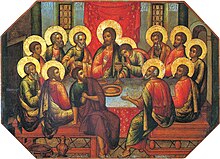
The institution of the Eucharist at the Last Supper is remembered by Roman Catholics every bit i of the Luminous Mysteries of the Rosary, the First Station of a so-called New Fashion of the Cross and past Christians equally the "inauguration of the New Covenant", mentioned by the prophet Jeremiah, fulfilled at the last supper when Jesus "took breadstuff, and later blessing it broke it and gave it to them, and said, 'Take; this is my body.' And he took a cup, and when he had given thanks he gave it to them, and they all drank of information technology. And he said to them, 'This is my blood of the covenant, which is poured out for many.'"[Mk. 14:22–24] [Mt. 26:26–28] [Lk. 22:nineteen–twenty] Other Christian groups consider the Bread and Wine remembrance to be a change to the Passover ceremony, equally Jesus Christ has become "our Passover, sacrificed for us",[1 Cor. 5:7] and hold that partaking of the Passover Communion (or fellowship) is now the sign of the New Covenant, when properly understood by the practicing believer.
These meals evolved into more than formal worship services and became codification as the Mass in the Catholic Church, and as the Divine Liturgy in the Eastern Orthodox Church; at these liturgies, Catholics and Eastern Orthodox gloat the Sacrament of the Eucharist. The proper noun "Eucharist" is from the Greek word εὐχαριστία (eucharistia) which ways "thanksgiving".
Early Christianity observed a ritual meal known equally the "agape feast"[a] These "love feasts" were apparently a total meal, with each participant bringing food, and with the meal eaten in a common room. They were held on Sundays, which became known equally the Sunday, to recall the resurrection, the appearance of Christ to the disciples on the route to Emmaus, the appearance to Thomas and the Pentecost which all took place on Sundays later on the Passion.
Passover parallels

Since the late 20th century, with growing consciousness of the Jewish character of the early church and the improvement of Jewish-Christian relations, it became common amid some lay people to associate the Concluding Supper with the Passover Seder.[ citation needed ] This is because the Synoptic Gospels describe it as a Passover repast.[ commendation needed ] Some evangelical groups borrowed Seder customs, like Haggadahs, and incorporated them in new rituals meant to mimic the Last Supper;[ citation needed ] likewise, many secularized Jews presume that the issue was a Seder. This identification is somewhat erroneous, every bit although it was most probable a Passover repast, it was co-ordinate to the 2d Temple Menstruation community and included the consumption of a full lamb. The earliest elements in the current Passover Seder (a fortiori the full-fledged ritual, which is offset recorded in full only in the ninth century) are a rabbinic enactment instituted in remembrance of the Temple, which was still standing during the Last Supper.[56]
The Gospel of Judas, a piece of work belonging to early Gnosticism, features a story of Jesus meeting with his disciples as they bless staff of life with a prayer of thank you, recalling accounts of the Concluding Supper, Eucharist or some other holy repast.[57]
The 5th chapter in the Quran, Al-Ma'ida (the table) contains a reference to a repast (Sura v:114) with a tabular array sent down from God to ʿĪsá (i.eastward., Jesus) and the apostles (Hawariyyin). However, there is cypher in Sura 5:114 to indicate that Jesus was celebrating that meal regarding his impending death, specially as the Quran states that Jesus was never crucified to begin with. Thus, although Sura 5:114 refers to "a meal", there is no indication that information technology is the Last Supper.[58] Notwithstanding, some scholars believe that Jesus' fashion of speech during which the table was sent down suggests that it was an affidavit of the apostles' resolves and to strengthen their faiths equally the impending trial was most to befall them.[59]
Historicity
Co-ordinate to John P. Meier and E. P. Sanders, Jesus having a last repast with his disciples is almost across dispute among scholars, and belongs to the framework of the narrative of Jesus's life.[60] [61] I. Howard Marshall states that any doubt well-nigh the historicity of the Terminal Supper should exist abandoned.[11]
Some Jesus Seminar scholars consider the Concluding Supper to have derived non from Jesus' concluding supper with the disciples but rather from the gentile tradition of memorial dinners for the dead.[62] In their view, the Terminal Supper is a tradition associated mainly with the gentile churches that Paul established, rather than with the before, Jewish congregations.[62] Such views echo that of 20th century Protestant theologian Rudolf Bultmann, who also believed the Eucharist to take originated in Gentile Christianity.[16] [17]
On the other hand, an increasing number of scholars has reasserted the historicity of the institution of the Eucharist, reinterpreting it from a Jewish eschatological point of view: co-ordinate to Lutheran theologian Joachim Jeremias, for example, the Final Supper should be seen equally a climax of a series of Messianic meals held by Jesus in anticipation of a new Exodus.[63] Similar views are echoed in more recent works past Catholic biblical scholars John P. Meier and Brant Pitre and by Anglican scholar N.T. Wright.[64] [14] [65]
Many early Church Fathers have attested to the conventionalities that at the Final Supper, Christ made the promise to be nowadays in the Sacrament of the Eucharist, with attestations dating back to the first century AD.[66] [67] [68] [69] [lxx] [71] [72] [73] The didactics was also affirmed by many councils throughout the Church building's history.[74] [75]
Artistic depictions
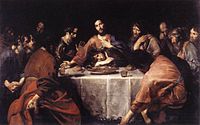
The Last Supper has been a pop subject in Christian art.[1] Such depictions date back to early Christianity and can be seen in the Catacombs of Rome. Byzantine artists often focused on the Apostles receiving Communion, rather than the reclining figures having a meal. By the Renaissance, the Last Supper was a favorite topic in Italian art.[76]
At that place are three major themes in the depictions of the Last Supper: the starting time is the dramatic and dynamic depiction of Jesus'southward annunciation of his betrayal. The second is the moment of the institution of the tradition of the Eucharist. The depictions here are generally solemn and mystical. The third major theme is the farewell of Jesus to his disciples, in which Judas Iscariot is no longer present, having left the supper. The depictions here are generally melancholy, as Jesus prepares his disciples for his divergence.[1] There are also other, less frequently depicted scenes, such as the washing of the feet of the disciples.[77]
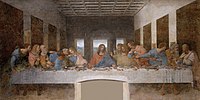
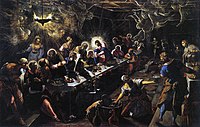
Well known examples include Leonardo da Vinci'due south depiction, which is considered the start work of Loftier Renaissance art due to its high level of harmony,[78] Tintoretto's depiction which is unusual in that information technology includes secondary characters carrying or taking the dishes from the tabular array[79] and Salvadore Dali'southward depiction combines the typical Christian themes with modern approaches of Surrealism.[80]
- Depictions of Last Supper
-
-
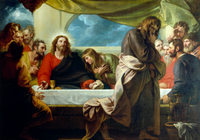
The Terminal Supper (Nighttime side of the Eucharist), by Benjamin West, mid 18 century
-
-

The first Eucharist, depicted by Juan de Juanes in The Last Supper, c. 1562
-

Miniature depiction from c. 1230
-
-

Last Supper, sculpture, c. 1500
-

The Last Supper, by Bouveret, 19th century
-

Music
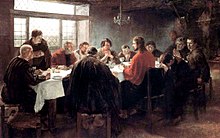
The Lutheran Passion hymn "Da der Herr Christ zu Tische saß" (When the Lord Christ sat at the table) derives from a depiction of the Last Supper.[ importance of example(s)? ]
See also
- Book of the Underground Supper
- Friday the 13th
- Life of Jesus in the New Testament
- List of dining events
References
Notes
- ^ Agape is ane of the 4 principal Greek words for love (Lewis 1960). It refers to the idealised or high-level unconditional love rather than animalism, friendship, or amore (as in parental affection). Though Christians interpret Agape as meaning a divine form of love beyond human forms, in modern Greek the term is used in the sense of "I love yous" (romantic love).
Citations
- ^ a b c Zuffi 2003, pp. 254–259.
- ^ Cross & Livingstone 2005, p. 958, Last Supper.
- ^ Windsor & Hughes 1990, p. 64.
- ^ Hazen 2002, p. 34.
- ^ a b c d e f Evans 2003, pp. 465–477.
- ^ a b c d e f g Fahlbusch 2005, pp. 52–56.
- ^ a b Cantankerous & Livingstone 2005, p. 570, Eucharist.
- ^ Kruse 2004, p. 103.
- ^ Bromiley 1979, p. 164.
- ^ a b Wainwright & Tucker 2006.
- ^ a b Marshall 2006, p. 33. sfn mistake: no target: CITEREFMarshall2006 (assistance)
- ^ Jeremias 1966, p. 51–62.
- ^ Meier 1991, pp. 302–309.
- ^ a b Pitre 2011. sfn error: no target: CITEREFPitre2011 (help)
- ^ Funk 1998, pp. ane–40, Intruduction.
- ^ a b Bultmann 1963. sfn fault: no target: CITEREFBultmann1963 (help)
- ^ a b Bultmann 1958. sfn error: no target: CITEREFBultmann1958 (assistance)
- ^ Armentrout & Slocum 1999, p. 292.
- ^ a b Fitzmyer 1981, p. 1378.
- ^ Bower 2003, pp. 115–116.
- ^ Anon. 1992, p. 37.
- ^ Thompson 1996, pp. 493–494.
- ^ McGuckin 2010, pp. 293, 297.
- ^ a b Benedict XVI 2007.
- ^ Harrington 2001, p. 49.
- ^ Cox & Easley 2007, p. 182.
- ^ Marshall et al. 1996, p. 697.
- ^ Blomberg 2009, p. 333.
- ^ Brown et al. 626[ incomplete curt commendation ]
- ^ Freedman 2000, p. 792.
- ^ Perkins 2000, p. 85.
- ^ Lange 1865, p. 499.
- ^ Harris 1985, pp. 302–311.
- ^ Köstenberger 2002, pp. 149–151.
- ^ a b Yarbrough 2008, p. 215.
- ^ Funk & Hoover 1993.
- ^ a b Ridderbos 1997, pp. 546–76.
- ^ Barnett 2002, pp. 19–21.
- ^ Riesner 1998, pp. nineteen–27.
- ^ Köstenberger, Kellum & Quarles 2009, pp. 77–79.
- ^ Humphreys 2011, pp. 62–63.
- ^ Mershman 1912.
- ^ Light-green 1990, p. 333.
- ^ Benedict XVI 2011, pp. 106–115.
- ^ Humphreys 2011, pp. 162, 168.
- ^ Narayana 2011.
- ^ Telford 2015, pp. 371–376.
- ^ Pixner 1990.
- ^ Kilgallen 265[ incomplete short citation ]
- ^ a b c Dauphinais & Levering 2005, p. xix.
- ^ a b Wawrykow 2005a, pp. 124–125.
- ^ Pope 2002, p. 22.
- ^ Wawrykow 2005b, p. 124.
- ^ Rice & Huffstutler 2001, pp. 66–68.
- ^ a b c Chen 2008, pp. 62–68.
- ^ Poupko & Sandmel 2017.
- ^ Kasser et al. 2008, p. 11.
- ^ Beaumont 2005, p. 145.
- ^ Khalife 2012.
- ^ Sanders 1995, pp. x–11.
- ^ Meier 1991, p. 398.
- ^ a b Funk 1998, pp. 51–161, Marker.
- ^ Jeremias 1966, p. 51-62.
- ^ Meier 1994, pp. 302–309. sfn error: no target: CITEREFMeier1994 (aid)
- ^ Wright 2014. sfn error: no target: CITEREFWright2014 (help)
- ^ Justin Martyr. "The Offset Apology".
- ^ Irenaeus of Lyons. "Against Heresies".
- ^ Clement of Alexandria. "The Paedagogus (Book I)".
- ^ Ignatius of Antioch. "The Epistle of Ignatius to the Smyrnaeans".
- ^ Ignatius of Antioch. "The Epistle of Ignatius to the Ephesians".
- ^ Ignatius of Antioch. "The Epistle of Ignatius to the Romans".
- ^ Tertullian. "On the Resurrection of the Flesh".
- ^ Augustine of Hippo. "Exposition on Psalm 33 (mistakenly labelled 34)".
- ^ "Kickoff Quango of Nicæa (A.D. 325)".
- ^ "Quango of Ephesus (A.D. 431)".
- ^ McNamee 1998, p. 22–32.
- ^ Zuffi 2003, p. 252.
- ^ Buser 2006, pp. 382–383.
- ^ Nichols 1999, p. 234.
- ^ Stakhov & Olsen 2009, pp. 177–178.
Sources
- Betimes. (1992). Liturgical Year: The Worship of God. Supplemental liturgical resources. Presbyterian Publishing Corporation. ISBN978-0-664-25350-9.
- Armentrout, D.S.; Slocum, R.B. (1999). An Episcopal Dictionary of the Church: A Convenient Reference for Episcopalians. Church Publishing Incorporated. ISBN978-0-89869-211-two.
- Barnett, Paul (2002). Jesus and the Ascent of Early Christianity. A History of New Testament Times. ISBN0830826998.
- Beaumont, Ivor Marking (2005). Christology in dialogue with Muslims. ISBN1870345460.
- Benedict XVI (five April 2007). "Mass of the Lord's Supper". vatican.va . Retrieved 2 April 2021.
- Benedict Xvi (2011). "The Dating of the Last Supper". Jesus of Nazareth. Cosmic Truth Lodge and Ignatius Press. ISBN978-1586175009.
- Blomberg, Craig (2009). Jesus and the Gospels. Nashville: B & H Pub. Group. ISBN978-1-4336-6842-5. OCLC 727647948.
- Bower, Peter (2003). The companion to the Volume of mutual worship. Louisville, Ky: Geneva Press Function of Theology and Worship, Presbyterian Church (U.South.A. ISBN0-664-50232-6. OCLC 51059177.
- Buser, Thomas (2006). Experiencing art around us. Commonwealth of australia United States: Thomson Wadsworth. ISBN978-0-534-64114-6. OCLC 58986528.
- Casey, Maurice (2010). Jesus of Nazareth: An Contained Historian's Account of His Life and Teaching. A&C Black. ISBN978-0-567-64517-3.
- Chen, David (2008). Calvin'south passion for the church and the Holy Spirit. United States: Xulon Press. ISBN978-1-60647-346-seven. OCLC 459711693.
- Cox, Steven; Easley, Kendell H. (2007). Harmony of the Gospels. Nashville, Tenn: Holman Bible Pub. ISBN978-0-8054-9444-0. OCLC 83596188.
- Bromiley, G. Due west. (1979). The International Standard Bible Encyclopedia. Vol. iii. Wm. B. Eerdmans. ISBN9780802837837.
- Cantankerous, F. L.; Livingstone, Eastward. A. (2005). The Oxford Dictionary of the Christian Church building (third rev. ed.). Oxford; New York: Oxford Academy Press. ISBN9780192802903.
- Dauphinais, Michael; Levering, Matthew, eds. (2005). Reading John with St. Thomas Aquinas. ISBN9780813214054.
- Dix, Gregory} (1945). The Shape of the Liturgy. Dacre Press.
- Ehrman, Bart D. (2005). Misquoting Jesus: The Story Behind Who Changed the Bible and Why. HarperCollins. ISBN978-0060738174.
- Ehrman, Bart D. (9 July 2016). "Did Matthew Write in Hebrew? Did Jesus Institute the Lord'southward Supper? Did Josephus Mention Jesus? Weekly Readers' Mailbag July 9, 2016". The Bart Ehrman Blog . Retrieved nine July 2021.
{{cite web}}: CS1 maint: url-status (link) - Evans, Craig A. (2003). The Bible Knowledge Background Commentary. ISBN0781438683.
- Fahlbusch, Erwin (2005). The Encyclopedia of Christianity. Vol. 4. ISBN978-0802824165.
- Fitzmyer, Joseph, ed. (1981). The Gospel co-ordinate to Luke : introduction, translation, and notes. Vol. 28A. Garden City, N.Y: Doubleday. ISBN0-385-00515-vi. OCLC 6918343.
- Freedman, D. North. (2000). Eerdmans dictionary of the Bible. Grand Rapids, MI: Eerdmans. ISBNxc-5356-503-5. OCLC 782943561.
- Funk, Robert W.; Hoover, Roy W. (1993). The five gospels. Jesus Seminar. HarperSanFrancisco.
- Funk, Robert W. (1998). The acts of Jesus: the search for the accurate deeds of Jesus. Jesus Seminar. HarperSanFrancisco.
- Green, William Scott (1990). Judaism and Christianity in the first century. ISBN9780824081744.
- Harrington, Daniel (2001). The church according to the New Testament : what the wisdom and witness of early Christianity teach us today. Franklin, Wis: Sheed & Ward. ISBNone-58051-111-two. OCLC 47869562.
- Harris, Stephen L. (1985). "John". Understanding the Bible. Palo Alto: Mayfield.
- Hazen, Walter (2002). Inside Christianity. Lorenz Educational Printing. ISBN978-0787705596.
- Humphreys, Colin J. (2011). The Mystery of the Last Supper. Cambridge: University Press. ISBN978-0521732000.
- Jeremias, J. (1966). The Eucharistic Words of Jesus. New Testament library. Scribner.
- Kasser, R.; Meyer, Yard.; Wurst, K.; Gaudard, F. (2008). The Gospel of Judas, Second Edition. National Geographic Society. ISBN978-1-4262-0415-9.
- Khalife, Maan (2012). "Last Supper of Jesus Co-ordinate to Islam".
- Köstenberger, Andreas (2002). Encountering John : the Gospel in historical, literary, and theological perspective. Grand Rapids, Mich: Bakery Academic. ISBN0-8010-2603-2. OCLC 52964348.
- Köstenberger, Andreas J.; Kellum, Leonard Scott; Quarles, Charles L. (2009). The cradle, the cross, and the crown : an introduction to the New Attestation. Nashville, Tenn: B & H Bookish. ISBN978-0-8054-4365-3. OCLC 369138111.
- Kruse, Colin G. (2004). The Gospel co-ordinate to John. ISBN0802827713.
- Lange, Johann Peter (1865). The Gospel according to Matthew. Vol. one. New York: Charles Scribner.
- Lewis, C. Southward. (1960). The Four Loves. Geoffrey Bles. OCLC 30879763.
- Marshall, I. Howard; Millard, A. R.; Packer, J. I.; Wiseman, by Donald J. (1996). New Bible dictionary (3rd ed.). Leicester: InterVarsity Printing. ISBN978-0-8308-1439-viii. OCLC 34943226.
- McGuckin, John (2010). The Orthodox Church : an Introduction to its History, Doctrine, and Spiritual Civilisation. Hoboken: John Wiley & Sons, Ltd. ISBN978-1-4443-3731-0. OCLC 811493276.
- McNamee, Maurice (1998). Vested angels : eucharistic allusions in early Netherlandish paintings. Leuven: Peeters. ISBN978-90-429-0007-three. OCLC 39715499.
- Meier, John P. (1991). A Marginal Jew: The roots of the problem and the person. Doubleday. p. 398. ISBN978-0-385-26425-9.
- Mershman, Francis (1912). . In Herbermann, Charles (ed.). Catholic Encyclopedia. Vol. 14. New York: Robert Appleton Company.
- Narayana, Nagesh (xviii April 2011). "Last Supper was on Wednesday, non Thursday, challenges Cambridge professor Colin Humphreys". International Business Times . Retrieved 28 Baronial 2021.
- Nichols, Tom (1999). Tintoretto : tradition and identity. London: Reaktion. ISBN1-86189-120-ii. OCLC 41958923.
- Perkins, Pheme (2000). Peter : campaigner for the whole church. Edinburgh: T. & T. Clark. ISBN0-567-08743-3. OCLC 746853124.
- Pixner, Bargil (May–June 1990). "The Church of the Apostles found on Mount Zion". Biblical Archæology Review. 16 (3). Archived from the original on 9 March 2018.
{{cite journal}}: CS1 maint: date and yr (link) - Pope, Stephen (2002). The ethics of Aquinas. Washington, D.C: Georgetown University Printing. ISBN0-87840-888-half dozen. OCLC 47838307.
- Poupko, Yehiel; Sandmel, David (6 April 2017). "Jesus Didn't Eat a Seder Meal". ChristianityToday.com . Retrieved 28 August 2021.
- Ridderbos, Herman (1997). "The Farewell Prayer". The Gospel according to John: a theological commentary. Grand Rapids, Mich: W.B. Eerdmans Pub. ISBN978-0-8028-0453-2. OCLC 36133366.
- Rice, Howard; Huffstutler, James C. (2001). Reformed worship. Louisville: Geneva Press. ISBN0-664-50147-8. OCLC 45363586.
- Riesner, R. (1998). Paul's Early Catamenia: Chronology, Mission Strategy, Theology. Translated by D. Stott. W.B. Eerdmans. ISBN978-0-8028-4166-7.
- Sanders, E. P. (1995). The Historical Figure of Jesus. Penguin. ISBN978-0140144994.
- Stakhov, A.P.; Olsen, S.A. (2009). The Mathematics of Harmony: From Euclid to Gimmicky Mathematics and Computer Science. Yard & E series on knots and everything. World Scientific. ISBN978-981-277-582-5.
- Telford, William R. (2015). "Review of The Mystery of the Last Supper: Reconstructing the Final Days of Jesus". The Journal of Theological Studies. 66 (one): 371–76. doi:x.1093/jts/flv005.
- Thompson, B. (1996). Humanists and Reformers: A History of the Renaissance and Reformation. Wm B. Eerdmans. ISBN978-0-8028-6348-5.
- Vermes, Geza (2004). The authentic gospel of Jesus. London: Penguin.
- Wainwright, One thousand.; Tucker, One thousand.B.West. (2006). The Oxford History of Christian Worship. Oxford University Press, Usa. ISBN978-0-19-513886-3.
- Wawrykow, Joseph (2005a). The A-Z of Thomas Aquinas. London: SCM Press. ISBN0-334-04012-four. OCLC 61666905.
- Wawrykow, Joseph (2005b). The Westminster handbook to Thomas Aquinas. Louisville, Ky: Westminster John Knox Printing. ISBN978-0-664-22469-1. OCLC 57530148.
- Windsor, Gwyneth; Hughes, John (1990). Worship and Festivals. Heinemann. ISBN978-0435302733.
- Yarbrough, Robert (2008). one-3 John. One thousand Rapids, Mich: Baker Academic. ISBN978-0-8010-2687-4. OCLC 225852361.
- Zuffi, Stefano (2003). Gospel figures in art. Los Angeles: J. Paul Getty Museum. ISBN978-0892367276.
External links
- "Last Supper" on Encyclopædia Britannica Online.
Source: https://en.wikipedia.org/wiki/Last_Supper

Post a Comment for "When the Meal Was Over Again He Took the Cup"